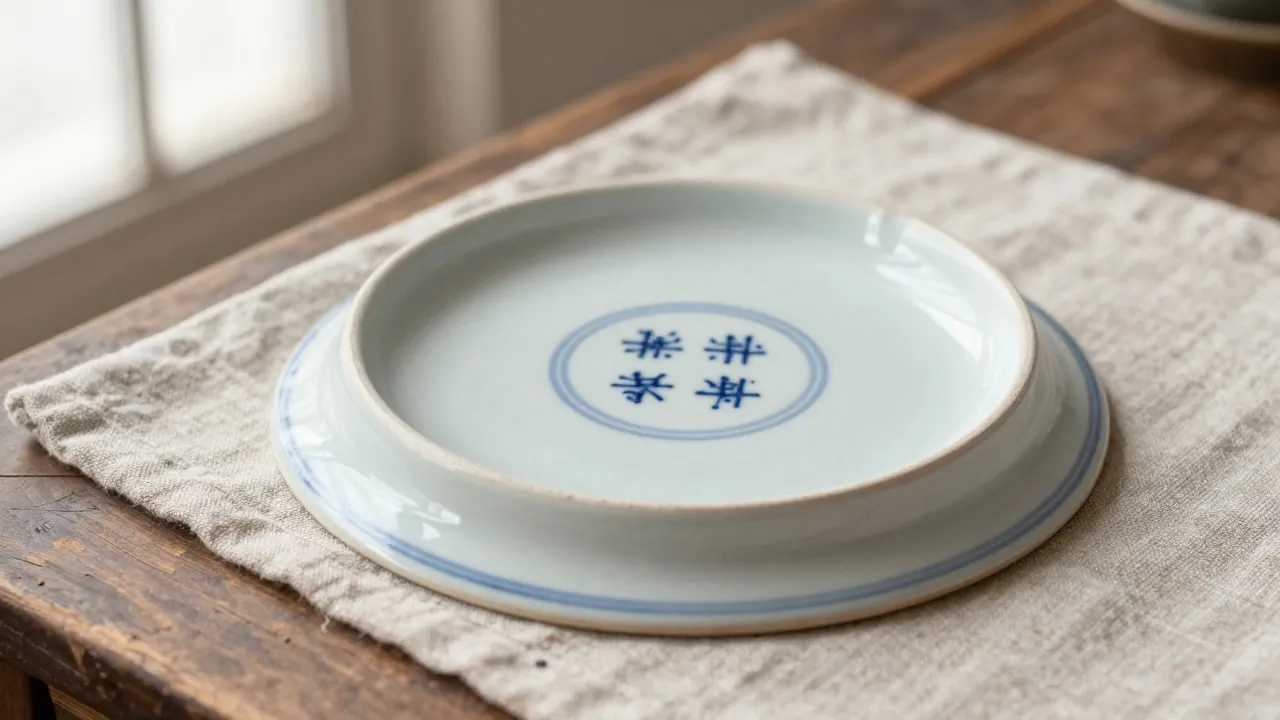
Antique Chinese plate markings are the characters, seals or symbols painted, stamped or incised on the base of a plate. The most common is a reign mark naming a Ming or Qing emperor. A mark tells you which reign the plate claims, not when it was made, so you read it together with the porcelain, glaze and painting.
Antique Chinese plate markings fall into a few families. Reign marks give a dynasty and an emperor's reign name, usually in four or six characters inside a double circle, and the six-character version ends in nian zhi, meaning "made in the reign of." Hall and studio marks name a workshop or a studio, symbol marks use a leaf, fungus or other small emblem, and English words such as CHINA or Made in China come from import labeling rules in the buyer's country, not from Chinese tradition. Reading the characters is the easy part. Deciding whether the plate really belongs to the reign it names is harder, because potters copied earlier reign marks for centuries, often out of admiration for a celebrated period, so a mark alone can make a newer piece look older. Museums date a marked piece by checking the mark against the clay body, glaze, foot rim, painting style and quality of the calligraphy, and even then the date range they give can be narrower than the reign. Treat a mark as a claim to test, not as proof of age or value.
What counts as a marking on a Chinese plate
Turn the plate over and look inside the foot rim. Most marks sit in the center of the base, usually painted in underglaze cobalt blue, though some are in red or other enamels, and a few are stamped or incised into the clay.
You'll usually find one of four kinds:
| Mark type | What it looks like | What it tells you |
|---|---|---|
| Reign mark | Four or six characters, often in a double circle or square | The dynasty and emperor's reign the piece claims |
| Hall or studio mark | Characters naming a hall, studio or workshop, often ending in tang (hall) | Who ordered or made it, not always a date |
| Symbol mark | A leaf, fungus, scepter head or other small emblem, sometimes in a double circle | Usually a workshop or auspicious sign |
| English origin mark | CHINA or Made in China, printed or stamped | The piece was labeled for import into an English-speaking market |
Some plates have no mark at all. That's normal, and plenty of good older pieces were never marked.
How to read a six-character reign mark
Reign marks are written in vertical columns. You read the right column first, top to bottom, then move left. A horizontal mark is read right to left. Not every mark sits on the base, either: the British Museum's Room 95 gallery guide describes a Xuande fish bowl with its six-character reign mark painted near the rim.
A six-character mark breaks into three pairs:
- Right column, dynasty: Da Ming (Great Ming, 1368-1644) or Da Qing (Great Qing, 1644-1911).
- Middle column, reign name: for example Xuande, Chenghua, Kangxi, Yongzheng or Qianlong.
- Left column, nian zhi: "made in the reign of."
A four-character mark simply drops the dynasty pair.
A real example helps. The base of a blue and white bowl in the Victoria and Albert Museum carries a six-character mark inside a double circle reading Da Ming Xuande nian zhi, which the V&A translates as "Made in the reign of the Xuande emperor of the great Ming." It's dated 1426-1435, the span of that reign.
Some Qing marks are written in seal script, a squarer, more angular style. The British Museum's Room 95 guide, for example, describes ogee-shaped bowls with underglaze blue Qianlong seal marks on their bases. The characters look different, but the reading order is the same.
Mark and period vs. a later copied mark
When museums agree that a plate was actually made during the reign on its base, they write "mark and period." The Metropolitan Museum's dish with dragon amid waves is catalogued as Qianlong mark and period (1736-95): Jingdezhen porcelain painted in underglaze blue and overglaze red enamel, 7 inches (17.8 cm) across.
A mark alone isn't enough to earn that label. The V&A says its Xuande bowl was an imperial order because of the reign mark together with "the quality of materials and appearance," and that imperial wares were reserved for the household and for tributary gifts. In other words, the curators judged the bowl, not just the writing.
Copying earlier marks was common. According to the British Museum, the finest Chenghua doucai wares were so admired that potters at Jingdezhen imitated them for 500 years. Signs that a mark may be later than it claims:
- Thick, clumsy or uneven brushwork on a mark that claims an imperial reign
- A Ming reign mark on a plate whose shape, enamels or foot rim match a later style
- Painting, colors or a shape that look newer than the reign the mark names
Museum dates can also be tighter than the mark itself. The Met dates a Kangxi-marked peach-bloom vase to 1713-22, a much narrower window than the full 1662-1722 reign.
What "CHINA" or "Made in China" on the base means
An English word on the base has nothing to do with Chinese marking traditions. US law, 19 U.S.C. 1304, requires imported goods to be marked with "the English name of the country of origin" so the final buyer can see where they came from. A plate stamped CHINA or Made in China was labeled with that kind of rule in mind.
The same statute exempts articles "produced more than twenty years prior to its importation into the United States." That's why an older plate brought in as an antique often has no English mark at all, and why a missing CHINA stamp doesn't make a plate old by itself.
Federal rules add one more detail. Under 19 CFR 134.46, if a place name that isn't the true origin appears on an imported article, the real country has to appear nearby, in comparable size, after words such as "Made in" or "Product of." A Chinese reign mark names a period, not another country, so this rule doesn't apply to it. If Made in China does appear beside a reign mark, the English line tells you the plate was marked for an import market, which the reign mark alone never shows.
What decides the value of a marked plate
The mark points you toward a period. The plate itself decides what it's worth. When you compare your plate with sold examples, these are the things buyers weigh:
- Agreement between mark and plate. A mark-and-period piece sits in a different market from the same design with a later copied mark.
- Quality. Fine, even potting, a smooth glaze and confident painting matter more than how famous the emperor is.
- Condition. Chips, hairline cracks, worn enamels and old restorations all lower interest. Check the rim against a light.
- Decoration and form. Rare colors, unusual subjects and sought-after patterns attract more bidders.
- Who made it for whom. Pieces made for the court differ from everyday or export wares made in the same reign.
For a broader look at dating household pieces, browse the other guides on the antiques blog.
Reading a plate mark with Antiqly
If you can't read the characters, a photo is a good first step. Antiqly, available on iOS and Android, identifies an antique from a photo and suggests a name, period, origin and a short history. You can add up to four extra photos, such as the base and a close-up of the mark, plus a short note like "blue six-character mark in a double circle" to steer the identification. If a maker's mark is visible, the app describes it and gives its interpretation with a confidence level.
To try it, take a photo of your plate in Antiqly and see what it is and a price range. The range comes from comparable secondhand listings and shows how many listings it's based on. It's an estimate, not an appraisal, and a photo can't settle whether a mark is of the period. For a plate that may be valuable, or for insurance or an estate, have it examined by a qualified appraiser.
Common questions
How do I tell what dynasty a Chinese plate mark is from?
Read the right-hand column of a six-character mark first. Da Ming means the mark claims the Ming dynasty (1368-1644), and Da Qing means the Qing dynasty (1644-1911). The middle column names the emperor's reign. Remember the mark shows what the plate claims, so check the porcelain and painting too.
Does a reign mark prove my plate is old?
No. Potters copied earlier reign marks for centuries, often out of admiration for famous periods, so the writing alone can make newer work look older. Museums only call a piece mark and period when the clay, glaze, shape and painting fit the reign as well as the mark does.
Why does my Chinese plate have no mark?
Many plates were never marked, including a lot of everyday and export wares. Under US law, articles made more than twenty years before import don't need an English origin mark either, so an unmarked older plate is common.
What does a four-character Chinese mark mean?
A four-character reign mark is the short version of the six-character mark. It leaves out the dynasty and keeps the emperor's reign name plus nian zhi, meaning made in the reign of. Other four-character marks can be hall, studio or good-wish phrases.
Is Made in China on an old-looking plate a bad sign?
It means the plate was labeled for an import market with origin rules, so it's usually newer than a reign mark beside it suggests. Treat the English words as the stronger dating clue.