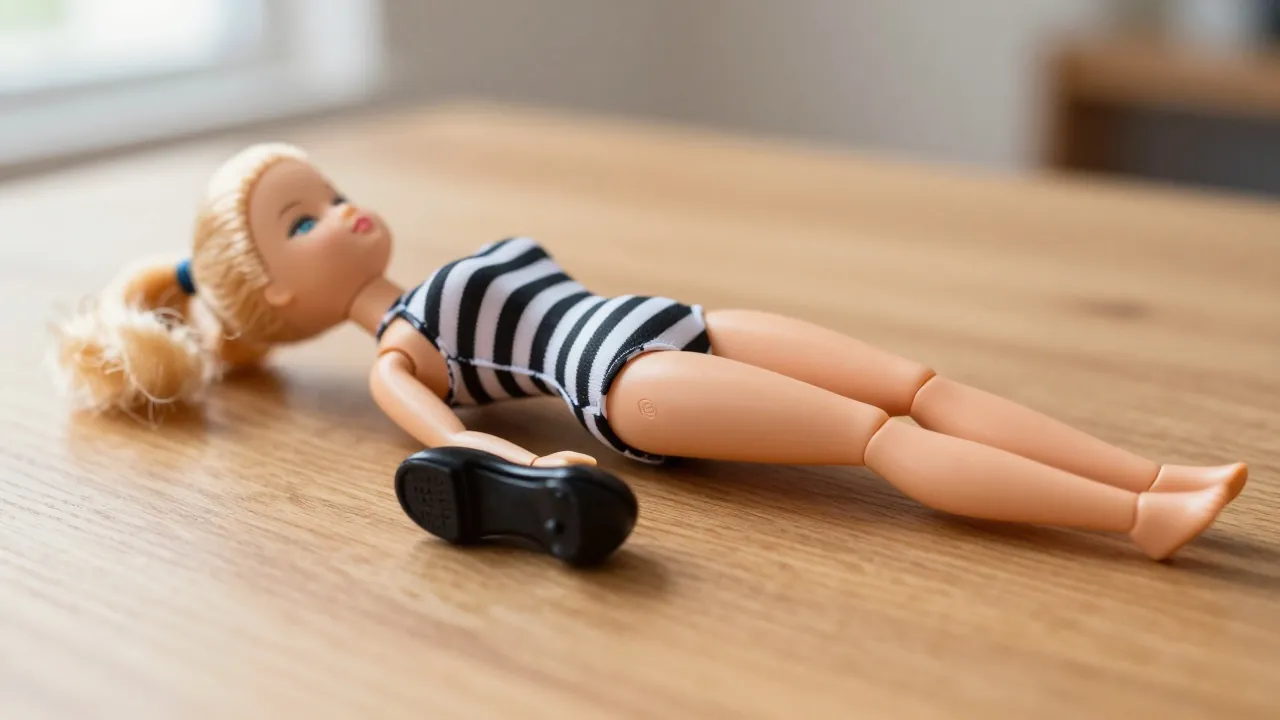
Barbie doll identification is the process of naming a Barbie and narrowing down when it was made by reading the molded marks on the hip and head, then checking the feet, hands, face paint, hair, wrist tag and box. The marks tell you the maker and a mold date; the other details narrow the doll to a period or a specific issue.
Barbie doll identification works from the most permanent evidence to the least. Start with the marks molded into the vinyl, usually on the hip or lower back and at the back of the head: they name Mattel, give a copyright or patent line with a year, and often a country such as Japan, Korea or Taiwan. That year belongs to the mold, not to the day your doll left the factory. Many later dolls reuse old molds. Next come the feet and shoes, which can carry their own marks, then the hands, face paint, eye color and hair. Paper evidence is the strongest of all when it survives: a wrist tag and the original box can print the stock number, the doll's name and even the hair color. Value is a separate question from identity. Once you know what the doll is, condition, completeness, original clothing and the box decide what it's worth, and a single change, like a repainted face or a swapped head, can take much of the value out of an otherwise rare doll.
Start With the Marks on the Hip and Head
Turn the doll over and look at the hip and lower back first, then lift the hair at the back of the head. Mattel molded its marks into the vinyl, so they survive when clothes, tags and boxes are long gone. A good light and a magnifier help; the letters are small and often worn.
An early example shows what you're looking for. The Victoria and Albert Museum's 1959 Teen Age Fashion Model Barbie is recorded with the hip mark "Barbie TM / Pats. Pend. / MCMLVIII / by / Mattel / Inc." MCMLVIII is 1958 in Roman numerals, and "Pats. Pend." means the patents were still pending. Later dolls usually carry a copyright symbol, a year in ordinary numbers and a country.
One caution: the year in the mark is tied to the mold, not to the day your doll was made. A body marked with an older year can come from a much later doll, so treat the mark as a starting point, not the answer.
Check the Feet and Shoes
The feet are the next place to look, and people often skip the shoes entirely. The Henry Ford's 1959 to 1961 Barbie has JAPAN stamped on the bottom of the foot. On the V&A doll, the tiny black heels carry their own molding: "390" and "JAPAN" underneath the left shoe.
So before you set a pair of shoes aside, turn them over. A country on the sole that matches the country on the body is a small but useful sign that the outfit and the doll belong to the same era. A mismatch doesn't prove anything is wrong, since children swapped clothes constantly, but write it down.
While you're there, look at the hands. Collector references describe early dolls with separated fingers and later bodies with fingers molded together, which helps when the marks alone don't settle the period.
Read the Face, Hair and Body Details
Face paint and hair are where one model splits into several versions. The V&A describes its 1959 doll as having blue eyes, heavy eyeliner, red lipstick, high arched painted eyebrows that match the hair, red painted fingernails and toenails, and a ponytail that's slightly curly at the front.
Compare your doll against details like these, but check for changes too. Common problems you'll run into:
- Repainted lips or eyebrows. Fresh, glossy paint that sits on top of wear is a warning sign.
- A swapped head. If the head and body marks point to different countries or periods, the doll may have been put together from two.
- Cut or restyled hair. Original factory hair is part of what collectors pay for.
- Green ear discoloration or faded skin. These affect condition, not identity, but note them.
Use the Wrist Tag and Box if You Have Them
Paper and packaging can name a doll outright. The Henry Ford's early Barbie came with a tag printed "GENUINE Barbie BY MATTEL" on the front and "Imported From Japan" on the back. Its box reads "TEEN AGE FASHION MODEL WITH PEDESTAL / STOCK No. 850 / BLOND PONYTAIL / JAPAN," so the box itself tells you the hair color the doll should have.
Boxes can even record where a doll was sold and for how much. The V&A's boxed Barbie still has a sticker on the base reading "F.W. Woolworth Co. / $3.00," its original store price.
| Where to look | What it may say | What it tells you |
|---|---|---|
| Hip or lower back | Mattel name, copyright or patent line, year, country | Maker and mold date, not exact production year |
| Back of head | Mattel and a year | Head mold; compare with the body |
| Foot and shoe soles | Country, sometimes a number | Factory country; whether shoes match |
| Wrist tag | "GENUINE Barbie BY MATTEL" | An original early accessory |
| Box | Doll name, stock number, hair color | The exact issue the doll should be |
Modern Dolls and Reproductions
Not every Barbie in a closet is vintage. Mattel kept adding dolls and kept reusing molds, so later dolls can look old at first glance. According to The Strong National Museum of Play, African American and Hispanic American Barbie dolls appeared in 1980, a Hawaiian Barbie in 1983 and a Chinese Barbie in 1993. Within a year of her 1959 introduction, the museum notes, Barbie was the biggest selling fashion doll, so a great many were made and sold.
Mattel has also reissued early designs for collectors. A reproduction can carry a very old year in its mark because it uses an old mold, while its box, tag and finish show it's newer. If the mark says 1958 but the vinyl looks fresh and the box has a modern barcode, read the box first.
What Decides What a Barbie Is Worth
Identification tells you what the doll is; value depends on what's left of it. The things that move the price most are condition of the face paint and hair, whether the body is all original, whether the outfit and shoes are the right ones, and whether the tag and box survived. A doll still in its box with original paper inserts sits at the top of the range; a played-with doll with a haircut and no clothes sits near the bottom, even if it's the same model.
Check completed sales of the same model in similar condition, not asking prices, because listings often sit unsold. For more guides on reading marks on other collectibles, browse the antique identification blog. If the doll could be an early issue in strong condition, or you need a figure for an estate or an insurer, get a written opinion from a qualified appraiser.
Using Antiqly to Identify a Barbie From Photos
If you'd like a quick first read before you start comparing references, Antiqly can help. Take a photo of the doll and add up to four extra photos of the hip mark, the back of the head, the feet and the box, plus a short note such as "marked Japan on the foot." Antiqly suggests a name, period and origin, describes any maker's mark it can see with a confidence level, and shows a price range based on comparable secondhand listings along with how many listings it used.
That range is an estimate, not an appraisal, and a photo can't confirm whether paint or hair has been changed. Antiqly is available on iOS and Android; for a valuable early doll, follow up with a qualified appraiser.
Common questions
How do I identify my Barbie doll?
Read the molded mark on the hip or lower back and at the back of the head, then check the feet and shoes for a country, and compare face paint, hair and hands with references. If you still have the wrist tag or box, read those last; they often print the doll's name, stock number and hair color.
Does the year on a Barbie's hip mean the year it was made?
No. The year is the copyright or patent year of the mold. Mattel reused molds for many years, so a doll marked with an early year can be much newer. Use the country, hands, face paint and packaging to narrow the real period.
What does MCMLVIII on a Barbie mean?
MCMLVIII is 1958 written in Roman numerals. It appears in the hip mark of the earliest Barbie dolls, together with Pats. Pend. and the Mattel name, as recorded on the 1959 doll in the Victoria and Albert Museum.
How much did the first Barbie cost?
A boxed early Barbie in the Victoria and Albert Museum still has an F.W. Woolworth Co. sticker reading $3.00, which shows the original store price for that doll. Today's value depends on condition, completeness and the box, not the original price.
Is my Barbie worth anything?
It depends on the model and, even more, on condition. Original hair and face paint, the correct outfit and shoes, and the original tag and box add the most. Compare completed sales of the same doll in the same condition before you decide.